

Daily, millions of photos, carousels, and videos join the Instagram platform network. Providing an individually customized stream of visual content to two billion-plus active users goes beyond simple user tagging and even static indexing of captions. The contemporary discovery algorithm uses advanced machine learning, multi-task deep learning, and real-time computer vision.
With these technologies, Instagram analyzes, clusters, and recommends visual assets on the pixel level and according to behavior patterns. It helps you to understand how AI processes visual media and gives recommendations on optimizing your workflows and simplify your Instagram growth strategy .
Instagram Discovery Algorithm Architecture Evolutions: From Chronological Feeds to Neural Networks
At its core level, the Instagram Discovery System used reverse chronological feed and keyword discovery based on the caption text as well as user-provided hashtags. With growing amounts of daily media, keyword discovery proved insufficient to match users’ preferences.
The Shift Toward Multi-Task Deep Learning Models
At present, Instagram uses advanced multi-task deep learning models ↗️. Instead of using separate engines to analyze individual feed components, multi-task neural networks consider hundreds of implicit and explicit signals at once. The models estimate user-specific actions (watch time, direct message sharing, saves, and comments) to generate a unique relevance score for every available post.
Understanding the Move from Keywords to Semantic Visual Context
Nowadays, the ranking pipelines take into account visual context based on pixel arrangements and audio spectral analysis. Text metadata is used as an auxiliary signal.
Machine learning algorithms extract contextual meaning directly from video frames, allowing the discovery system to recommend the content without the need to write comprehensive descriptions.
Decoding Pixels: How Instagram’s Computer Vision Actually Works
Computer vision enables automated systems to interpret visual data in a way similar to human perception. Instagram uses custom-made visual perception models that are trained on enormous volumes of visual data.
Object Detection, Scene Recognition, and Image Tagging
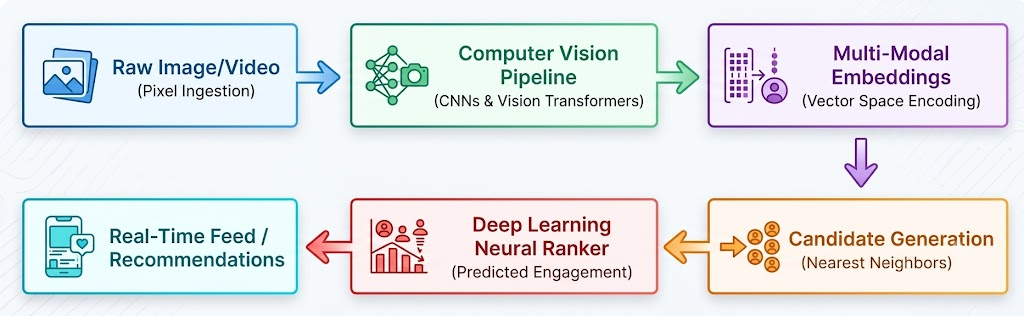
By using Convolutional Neural Networks (CNNs) ↗️ and Vision Transformers (ViTs), Instagram analyzes images through high-level features. This system automatically performs several recognition tasks:
- Object Labeling: Recognition of particular objects in a picture – clothes, animals, vehicles, sports equipment.
- Scene Parsing: Recognition of the environment around subjects – distinction of studio scenes from mountain landscapes and city streets.
- Text Processing (OCR): Recognition of overlay texts and embedded graphics in an image or video frame to validate visual relevance to the caption.
Facial Features and Image Aesthetics Evaluation
In addition to simple object recognition, computer vision systems can also evaluate aesthetics. Algorithms calculate image clarity, lighting contrast, color harmony, and composition balance. Files of low resolution, aggressive compression artifacts, or any watermarked images are immediately recognized, thus lowering their importance in global recommendation pools.
Inside the Recommendation Engine: Embeddings, Candidate Generation and Ranking
In order to create personalized recommendations, the system should narrow down billions of candidate items to the most suitable few thousand within milliseconds. Such a task is completed according to the following multilayer candidate generation and scoring procedure.
Vector Space Construction: The Clustering of Content
Media objects and user profiles are projected onto the same high-dimensional vector space using embeddings. If a user frequently engages with certain visual themes, the vector of their personal profile gradually gets closer to the vectors of these visual clusters.
Visual Embedding + Audio Embedding + Text Embedding = Vector Representation
Scoring and Filtering: The Prediction of the Engagement Probability
The deep ranking network gives an evaluation for the retrieved candidates from the candidate generation layer using approximate nearest-neighbor searches, predicting the probability scores for certain user actions:
- Probability of Watch Time: Prediction that the video will be watched beyond the first 3 seconds after starting to play.
- Probability of Private Sharing: The prediction of forwarding the post via Direct Message, which serves as a first-class ranking signal.
- Probability of Saving: Prediction of whether the object provides any reference value and needs to be saved.
Visual Search and the Next Era of Social Discovery
Social search algorithms have evolved from strictly text inputs to visually expanding queries. Searching is possible by using visual themes, tapping tags, or discovering related visual content via geographical visual clusters.
Transitioning From Strictly Text Queries to Multi-Modal Image and Video Search Engines
The multimodal search engines run queries on text, images, and sound snippets. Upon entering a query in the search engine box, the search engine runs queries on both text and image databases to return results that may be highly relevant but do not necessarily come with captions.
For companies and brands that seek sustainable development, it is recommended to test techniques that would increase organic visibility and Instagram views in order to form a consistent signal in multimodal search databases.
The Fight Against Manipulations: Artificial Intelligence Protects the Algorithm From Bots and Spam
To make sure that recommendation streams stay safe and interesting, visual machine learning techniques cooperate with the infrastructure of trust and safety.

Automation of Moderation and Real-Time Content Filtering
The computer vision networks scan the media files that users upload to the site for any policy violations, dangerous behavior, or sensational images. With the help of automated filters, the system detects non-original re-uploads by using perceptual hashes on a frame-by-frame level. Thus, the original authors of posts will get their content distributed first and ahead of other aggregator accounts.
Maintaining Authenticity in Recommendation Pools
Adversarial models analyze user interaction networks. Unexpected increases in inauthentic behavior, artificial view farms, or bot networks are identified and separated out to ensure the integrity of genuine user feedback.
Conclusion: Meeting the Future of Machine-Learned Social Media
The application of AI and computer vision technology has completely revolutionized the way visual content is analyzed, indexed, and distributed on Instagram. Through the transition from simple text metadata to multi-modal vector embeddings, Instagram is now able to create tailored content recommendations with impressive technical precision. For influencers and engineers, knowledge of these neural ranking systems offers a clear path forward for visual reach.